

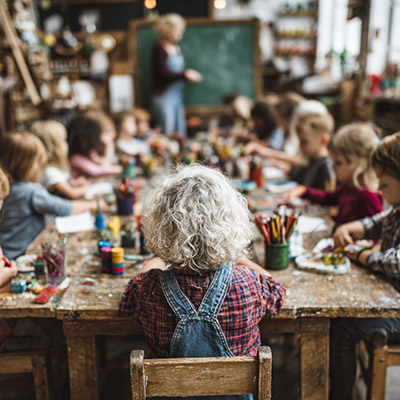
You have rehearsed this moment for weeks. You picked out the backpack together, read books about starting school, drove past the building so it would feel less foreign. And yet here you are, standing at the classroom door while your five-year-old grips your leg like you are the last solid thing in the universe. Her eyes fill with tears. Her fingers dig into your jeans. Every cell in your body screams to scoop her up and carry her home, where everything is safe and known and you never have to do this terrible thing called letting go.
The teacher catches your eye. Other parents file past, some looking sympathetic, others hurrying children who seem inexplicably fine. You crouch down, heart pounding, and say something you hope is reassuring. Then you walk away—or try to—and it feels less like parenting and more like betrayal.
If this scene sounds familiar, know that you are in abundant company. The kindergarten doorway is one of childhood's great thresholds, a place where developmental psychology and parental heartbreak collide every August and September. What unfolds there—the clinging, the tears, the reluctant departure—looks like a crisis but is actually something far more ordinary: separation anxiety doing exactly what evolution designed it to do.
• • •
To understand why your kindergartener is suddenly struggling with something that seemed resolved years ago, it helps to know a bit about what is happening in her developing brain.
Separation anxiety first appears around eight to ten months of age, when babies develop what psychologists call object permanence—the understanding that people and things continue to exist even when they cannot be seen. This cognitive milestone, ironically, creates its own distress. If you exist when you leave the room, you might also fail to return.
This early separation anxiety typically peaks between nine and eighteen months and resolves by age two or three, as children learn through repeated experience that caregivers do come back. But the brain is not done with this developmental chapter. Major transitions can trigger a re-emergence of separation fears even in children who seemed to have outgrown them entirely. Starting kindergarten—with its unfamiliar faces, new rules, and the longest daily separation many children have ever experienced—is precisely such a transition.
"Our brains associate 'novel' with 'dangerous,'" explains Dr. Barbara Bentley, a pediatric psychologist and clinical associate professor of developmental and behavioral pediatrics at Stanford Medicine Children's Health. This instinct served our ancestors well; caution in unfamiliar territory kept young humans alive. But in the context of a brightly lit kindergarten classroom, it can feel like a cruel evolutionary joke.
What parents often fail to realize—and what can provide real comfort once understood—is that this struggle at the classroom door is not evidence of fragility or failure. It is evidence of healthy attachment. A child who protests separation is a child who has formed a meaningful bond with her caregivers, a child whose internal compass is calibrated to seek safety in the people she trusts most. The fact that your child would rather stay with you is not something to worry about. It is something you built together, and it is good.
• • •
When Parents Feel It Too
Here is a truth that parenting advice rarely acknowledges: you may be experiencing your own separation anxiety, even as you try to manage your child's. This milestone is hard for parents too—the worry about whether she will be okay, the grief of watching her grow up, the guilt that comes from walking away while she cries. These feelings are not weakness. They are the natural consequence of loving someone so much it hurts.
The trouble is that children are remarkably attuned to their parents' emotional states. Developmental psychologists call this social referencing: the way young children look to trusted adults to determine whether a situation is safe. If a toddler stumbles and looks up to see her mother's panicked face, she cries. If she sees a calm, encouraging expression, she may simply get up and continue playing. The same dynamic operates at the kindergarten door, but the stakes feel higher.
"If Mom seems panicked or sad at drop-off, the child is likely to be scared too," says Dr. Gianna Frazee, a pediatrician at Stanford Medicine Children's Health. This creates an uncomfortable bind for parents: you must project confidence you may not feel, because your child is reading your face for information about whether the classroom is safe.
This does not mean you need to be genuinely calm inside—only that you need to appear calm outside, at least until you are out of sight. Several parents I spoke with admitted to crying in the car after drop-off, and many psychologists view this as perfectly healthy. Feel your feelings, just not in front of the child who needs to borrow your confidence. If you find yourself overwhelmed, it may help to remember that this performance of calm is itself an act of love—a gift you give your child so she can take her first steps into a wider world.
• • •
What Actually Helps
The research on what actually helps with separation anxiety is both clear and somewhat counterintuitive. The strategies that feel most natural—lingering to provide reassurance, waiting until your child stops crying, sneaking away to avoid a scene—tend to backfire. What works instead is a combination of preparation, brevity, and what might be called confident warmth.
Preparation begins weeks before school starts. Dr. Bentley recommends taking advantage of kindergarten orientation, open houses, or any opportunity to visit the classroom and meet the teacher before the first day. "The more kids know in advance, the less anxious they will be," she notes. Driving past the school, talking about what the daily routine will look like, and meeting even one classmate ahead of time can all help reduce the overwhelming novelty of day one. Some schools post information online about daily schedules and classroom activities; reviewing this together can help children feel prepared rather than ambushed.
The drop-off itself should be brief. "The more you linger, the more it tells the child it's not safe to separate," Dr. Bentley explains. This can be hard to hear when every instinct screams to stay and comfort, but the research is consistent: prolonged goodbyes tend to increase, not decrease, anxiety. A warm hug, a confident smile, a simple statement like "I know you'll have a great day, and I'll be right here when school is over"—and then you leave.
What matters is not the length of the goodbye but its consistency and confidence. Many families find it helpful to create a specific ritual: a secret handshake, a special phrase, a sequence of hugs and kisses that becomes predictable. This kind of routine provides structure and signals to the child that the world is orderly and safe. Some families have adopted rituals from popular children's books, like the palm kiss from Audrey Penn's The Kissing Hand, in which a mother raccoon kisses her son's palm so he can press the kiss to his cheek whenever he misses her during school. The ritual itself matters less than its consistency—something the child can hold onto when the parent cannot physically be there.
Transitional objects can also help. Dr. Bentley encourages kindergarteners to bring a small pocket-sized item from home—a tiny stuffed animal, a family photo tucked into a lunchbox, a lucky rock—as a reminder that they are loved and connected to home even in this new environment. For young children still developing an understanding of time, something tangible can bridge the gap between goodbye and reunion in a way that words alone cannot.
• • •
Different Children, Different Strategies
Not all children respond to the same strategies, and experienced parents know this viscerally. The child who dives into birthday parties with gleeful abandon may need only a quick kiss at the classroom door. The child who has always been slow to warm up—cautious with new people, sensitive to noise and stimulation, resistant to changes in routine—may need something more gradual.
Research suggests that approximately fifteen percent of children are temperamentally shy, meaning they approach unfamiliar situations with more wariness than their peers. For these children, writes Dr. Kristie Poole, a developmental psychologist at Brock University, unfamiliarity and unpredictability feed into feelings of fear. The potential for new teachers and new peers in a new environment can activate anticipatory anxiety that begins days or weeks before school starts.
For slow-to-warm-up children, extra preparation can make a meaningful difference. Multiple visits to the classroom before school starts, rather than just one. Meeting the teacher on several occasions. Talking through what the day will look like in specific, concrete detail, so there are fewer unknowns to fear. Some parents have found success with social stories—simple narratives that walk through what will happen, step by step—or with role-playing drop-off scenarios at home.
There is also the child who seems fine at drop-off but melts down later—at pickup, at home, in the middle of the night. This child may be holding it together through sheer effort during school hours and needs to release the accumulated stress in the safety of home. For these children, the work is less about the goodbye ritual and more about creating space for the emotional decompression afterward. They may need quieter afternoons, more physical affection, or simply an invitation to talk about how hard the day was without trying to fix it.
• • •
Working with Teachers
Teachers are essential allies in this transition, and most have extensive experience with separation anxiety. A kindergarten teacher has likely seen hundreds of tearful goodbyes and knows things that can help: which children need immediate engagement with a favorite activity, which respond well to a specific greeting, which need to be physically near the teacher for the first few minutes of the day.
It can help to communicate with your child's teacher before school starts—or as early as possible once it begins—about your child's specific temperament and what has worked in other settings. Many teachers are happy to send a quick text or email after drop-off to reassure anxious parents that their child has calmed down. (This is more common than you might think: many children who cry at the door are happily engaged within five or ten minutes.)
The goal is partnership. You and the teacher are working together to help your child feel safe enough to learn, and that collaboration matters. Dr. Mery Taylor, a psychologist at Children's Hospital of Orange County, suggests asking the teacher for specific strategies they have found effective and coordinating on how to handle particularly difficult mornings. This is not weakness or helicopter parenting; it is the kind of adult communication that supports children through hard transitions.
• • •
When to Seek Help
Most kindergarten separation anxiety resolves on its own within a few weeks as children adjust to their new routine. But in some cases, what looks like normal adjustment difficulty may be something more serious. Separation anxiety disorder is a clinical diagnosis that affects roughly four to five percent of school-age children, and distinguishing it from typical separation struggles is important.
The key criteria, according to Stanford Children's Health and the Diagnostic and Statistical Manual of Mental Disorders, involve duration, intensity, and interference with daily functioning. Separation anxiety becomes a clinical concern when symptoms persist for more than four weeks without improvement. Physical symptoms—recurring stomachaches, headaches, nausea, or vomiting associated with separation or the anticipation of separation—are another warning sign. So are sleep disturbances, including nightmares about separation, refusal to sleep alone, or excessive nighttime wakefulness.
School refusal is particularly significant. A child who occasionally protests going to school is normal; a child who consistently refuses, who develops intense distress at the thought of separation, or who seems inconsolable for extended periods may need professional support. Other warning signs include persistent, unrealistic fears that something bad will happen to parents or that they will not return, and anxiety that interferes with normal activities like play dates, after-school activities, or time with grandparents.
If you are concerned, the first step is usually a conversation with your child's pediatrician, who can help determine whether what you are seeing is within the normal range or warrants further evaluation. Treatment for separation anxiety disorder typically involves cognitive behavioral therapy, often with a family component, and the prognosis is generally excellent. Research suggests that early intervention matters: about one-third of childhood cases persist into adulthood if left untreated, but with appropriate support, most children learn to manage their anxiety and thrive.
• • •
The Bigger Picture
What can be hardest to hold onto, in the midst of a tear-streaked goodbye, is perspective. This phase is temporary. The child who clings to your leg today will not cling forever—though some mornings it may feel that way. With each day that passes, with each successful goodbye and reunion, she is building the internal confidence that you will return and that she can cope without you.
This is not just a difficult transition; it is also a profound one. Your child is learning that she can survive outside the orbit of your constant presence. She is learning that the world contains other trustworthy adults, other children who might become friends, other experiences that can be meaningful and even joyful. She is learning, in small increments, how to carry you with her even when you are not there.
And you are learning something too—the hardest thing perhaps that parenthood asks of us. You are learning that loving someone completely sometimes means walking away while they cry, trusting that the momentary pain is in service of their growth. You are learning that separation is not abandonment, that letting go is an act of faith, and that your child's capacity for independence is something you are building together, one difficult morning at a time.
The kindergarten door will not always feel like this. Soon enough—sooner than you think—she will wave goodbye with barely a backward glance, and you will feel something complicated: relief mixed with a small, strange grief for the child who needed you so completely. For now, though, the work is simply to show up, to project the confidence she needs, and to trust that what feels like an ending is actually a beginning.
Sources
- American Psychiatric Association. Diagnostic and Statistical Manual of Mental Disorders, Fifth Edition (DSM-5-TR). American Psychiatric Publishing, 2022.
- Bentley, Barbara, PsyD. "Helping Kids Cope with Separation Anxiety." Stanford Medicine Children's Health Blog, 2022.
- Children's Hospital of Philadelphia. "Separation Anxiety: What's Normal and When to Worry." CHOP Health Tips, 2024.
- Children's Hospital of Orange County. "Helping Kids Cope with Separation Anxiety." CHOC Health Hub, 2023.
- Cleveland Clinic. "Separation Anxiety in Children: A Guide for Parents." Cleveland Clinic Health Essentials, 2022.
- Ehrenreich, Jill T., et al. "Separation Anxiety Disorder in Youth: Phenomenology, Assessment, and Treatment." Psicologia Conductual, 2008.
- Estrada, Junabeth, and Narciso Rabara. "Separation Anxiety among Kindergarten Learners." Psychology and Education: A Multidisciplinary Journal, vol. 20, no. 8, 2024, pp. 1078–1094.
- Frazee, Gianna, MD. "How to Manage Your Child's Separation Anxiety." Stanford Medicine Children's Health Blog, 2025.
- National Association for the Education of Young Children. "Rocking and Rolling: Difficult Goodbyes." Young Children, 2020.
- Penn, Audrey. The Kissing Hand. Tanglewood Press, 1993.
- Poole, Kristie, PhD. "What Is Shyness? How to Support Shy Children Through Back-to-School Transitions." The Conversation, August 2023.
- Stanford Children's Health. "Separation Anxiety Disorder in Children." Stanford Medicine Children's Health, 2024.
- WebMD. "Separation Anxiety Disorder in Children." WebMD Parenting, 2024.
- Zero to Three. "Children with Shy or Slow to Warm Up Temperaments." Zero to Three Resources, 2025.