

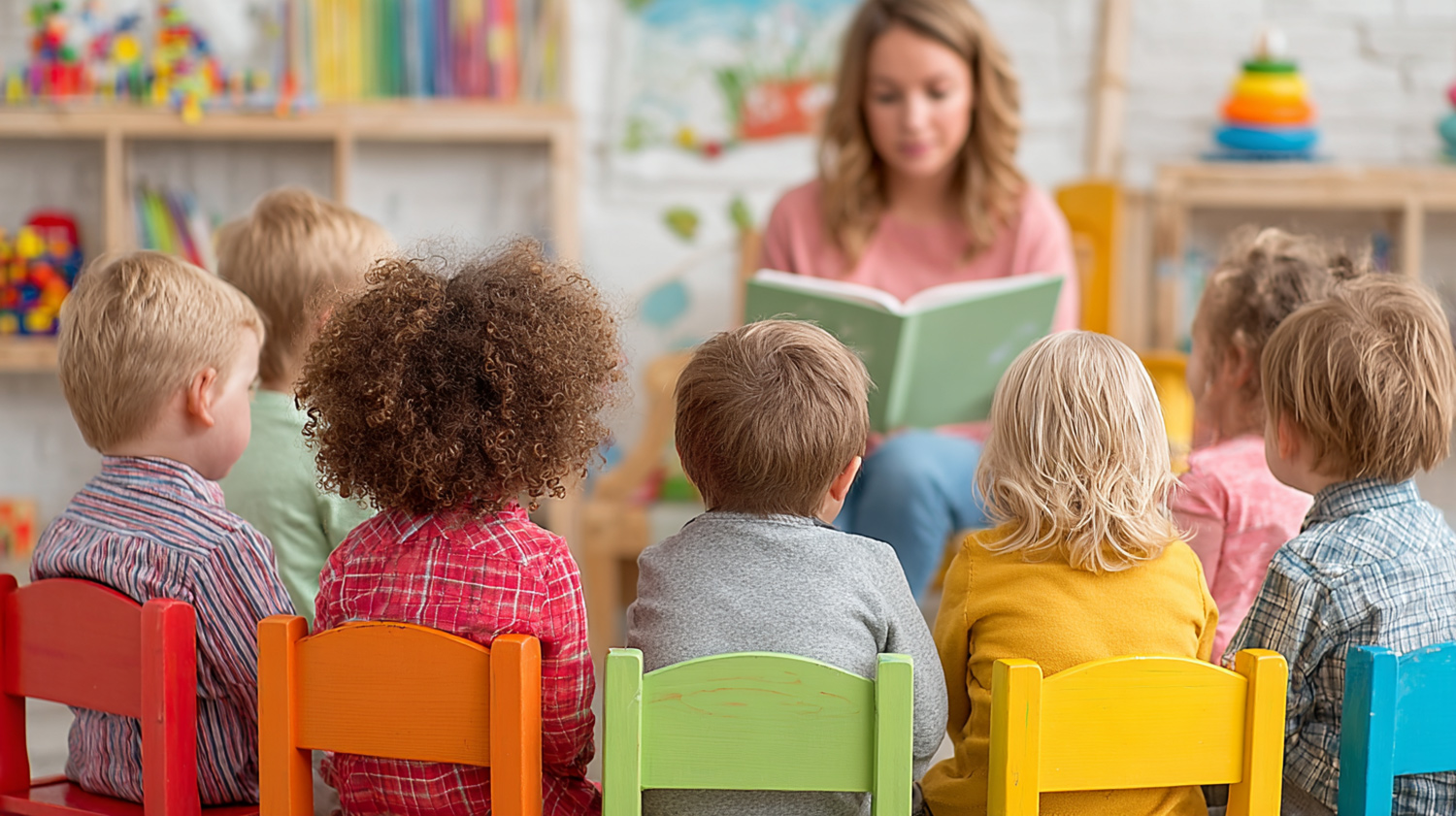
The preschool had all the right things. Wooden toys in muted colors. Child-sized furniture. A waiting list. The director spoke knowledgeably about sensitive periods and the prepared environment. Parents toured in hushed reverence, as though visiting a monastery.
And yet. In the corner of the classroom, a child was struggling to open a container, growing visibly frustrated. The teacher glanced over, said nothing, and returned to observing another child's work. The philosophy, presumably, was that children should solve their own problems. But the child's face told a different story—not productive struggle, but abandonment. She eventually gave up and wandered to another activity, shoulders slumped.
Down the street, a decidedly less prestigious preschool operated out of a church basement. The toys were plastic, the curriculum was technically "traditional," and there was no waiting list. But when a child struggled with a puzzle, the teacher knelt beside her, asked what she was trying to do, and offered just enough help to get her unstuck—then stepped back and let her finish. The child beamed.
Two schools, two philosophies, two very different moments. And in those moments, everything the research actually tells us about early childhood education.
• • •
We have been having the wrong conversation about preschool. For years, the debate has centered on educational philosophy—Montessori versus traditional, play-based versus academic, Reggio versus Waldorf. Parents research these approaches like they're choosing a religion, convinced that the right methodology will unlock their child's potential while the wrong one might somehow damage it.
The research tells a more interesting story. Philosophy matters, but less than you think. Implementation matters more. And what matters most of all is something that doesn't fit neatly on a brochure or a website: the quality of the relationships your child will form with the adults in the room.
This isn't sentimentality. It's what the data actually show.
• • •
The largest and most rigorous studies of preschool quality have converged on a surprisingly consistent finding. When researchers from the University of Virginia developed the Classroom Assessment Scoring System—now the most widely used measure of preschool quality in the country—they identified three domains that predict child outcomes: emotional support, classroom organization, and instructional support. Of these, emotional support has proven most consistently important, particularly for younger children.
What does emotional support look like in practice? Teachers who are warm and responsive. Teachers who notice when a child is struggling and intervene appropriately—not by solving the problem, but by providing the scaffolding the child needs to solve it themselves. Teachers who respect children's perspectives and take their ideas seriously. Teachers who create a classroom climate where children feel safe enough to take risks, make mistakes, and try again.
A major study of pre-K classrooms found that these qualities predicted child outcomes more strongly than curriculum type, class size, or teacher credentials. Children in classrooms with high emotional support showed greater gains in language, literacy, and social skills—regardless of whether the program called itself Montessori, traditional, or anything else.
Instructional support—the ability to extend children's thinking, ask open-ended questions, and provide feedback that helps children learn—also matters, particularly for cognitive and academic outcomes. But here's the thing: instructional support almost never exists without emotional support. Teachers who are cold or dismissive rarely excel at extending children's thinking. The relationship comes first.
• • •
None of this means educational philosophy is irrelevant. The research on Montessori education, in particular, is genuinely encouraging. Lottery-based studies have found that children in high-fidelity Montessori programs show advantages in reading, math, executive function, and social cognition. A 2023 meta-analysis of 33 studies found positive effects across multiple developmental domains. A 2025 national study found that Montessori preschoolers maintained advantages through kindergarten even after transitioning to conventional classrooms.
But look closer at that research and a crucial caveat emerges. The key phrase is "high-fidelity." When psychologist Angeline Lillard compared Montessori programs that adhered closely to Maria Montessori's original methods with those that supplemented the approach with conventional practices—worksheets, teacher-directed lessons, reward systems—only the classic programs showed consistent benefits. Schools that borrowed the name but diluted the method didn't produce the same outcomes.
What makes classic Montessori effective? Lillard's research suggests it's not the distinctive materials, charming as they are. It's the combination of child-directed activity, intrinsic motivation, and—crucially—teachers trained to observe carefully, intervene judiciously, and support children's autonomous development. In other words, it's a particular way of relating to children, embedded in a coherent philosophy that helps teachers understand what they're doing and why.
The same pattern appears in research on other approaches. An evaluation of Reggio Emilia programs in Italy found strong long-term outcomes—better employment, higher graduation rates, stronger social-emotional skills decades later. But when researchers compared Reggio graduates to children who attended other quality preschools, the differences largely disappeared. The Reggio philosophy works, but it may not work meaningfully better than other approaches that share its commitment to responsive, relationship-centered teaching.
• • •
If relationships matter most, how do you evaluate them when touring a preschool? You can't exactly ask a director, "Will your teachers form secure attachments with my child?" But you can watch. And what you watch for is more revealing than any curriculum description.
Watch what happens when a child is upset. Does a teacher notice? How quickly? What do they do? A teacher who ignores distress, or who responds with irritation, is telling you something important. A teacher who moves toward the child, gets down on their level, and helps them name what they're feeling is telling you something too.
Watch what happens when a child is stuck. The research on scaffolding—providing just enough support to help a child succeed at something slightly beyond their current ability—is robust and clear. Good teachers are constantly calibrating: this child needs encouragement, that one needs a hint, another needs to be left alone to figure it out. Poor teachers either abandon children to frustration or swoop in and do things for them. Both responses feel like help; neither actually is.
Watch the ratio of positive to negative interactions. Researchers have found that classrooms with more positive than negative teacher-child interactions produce better outcomes across the board. This doesn't mean teachers should never correct behavior or set limits—children need boundaries. But the overall emotional climate should be warm. If a classroom feels tense, controlling, or punitive, trust that feeling.
Watch how teachers talk to children. Are they asking genuine questions, or just quizzing? "What color is this?" is a quiz. "What do you notice about these two things?" is a question. Teachers who ask real questions—and then actually listen to the answers—are treating children as thinkers. That orientation predicts stronger cognitive and language outcomes.
And watch the children themselves. Are they engaged and purposeful, or drifting? Do they seem to know what they're doing and why? Do they approach teachers comfortably, or avoid them? Children are remarkably good at revealing the emotional climate of a classroom if you know how to look.
• • •
There's another variable that rarely appears on preschool tours but matters enormously: teacher stability. The research on this is stark. Children form attachments to their caregivers, and those attachments take time to develop. When teachers leave mid-year—or when a school has high turnover generally—children pay the price in ways that don't show up immediately but compound over time.
Ask how long the teachers have been at the school. Ask about turnover. If the answer is vague or evasive, that's information. A school that can't retain teachers is a school where something isn't working—compensation, administration, working conditions—and your child will experience the downstream effects.
This is one area where expensive private preschools sometimes fail. The prestige school with the beautiful campus may pay its teachers poorly and treat them as interchangeable. The humble church-basement program may have a lead teacher who's been there for fifteen years because she loves the work and the community supports her. Your child won't remember the aesthetic of the classroom. They will remember—in ways that shape them—whether the adults in their life were consistently present.
• • •
The focus on relationships also explains something that puzzles many parents: why the research on academic preschools is so discouraging. Programs that emphasize direct instruction in letters and numbers often show short-term gains on measures of those specific skills. But multiple studies have found that these gains fade quickly—sometimes by first grade, almost always by third. Some research suggests that highly academic preschools may actually harm children's long-term outcomes, particularly their motivation and engagement with learning.
Why would teaching letters and numbers backfire? The most plausible explanation centers on relationships—both the child's relationship with learning and their relationship with adults. Academic preschools tend to be more teacher-directed, with less opportunity for child-initiated activity. The interactions are more evaluative: right or wrong, good job or try again. Children may learn their letters, but they may also learn that learning is something done to them rather than by them, that adults are judges rather than partners, and that the goal is to produce correct answers rather than to explore and understand.
A 2021 study tracking adults who had attended Montessori as children found they reported higher wellbeing across multiple measures—and the more years of Montessori, the stronger the association. We can't know for certain what caused this, but it's consistent with the idea that early experiences of autonomy, competence, and supportive relationships create templates that persist. Children who learn that they can direct their own learning, that adults will support without controlling them, and that struggle is a normal part of growth may carry those lessons forward in ways that matter far more than early alphabet recognition.
• • •
This brings us to the real question underlying most preschool anxiety: what actually predicts long-term success?
The research here may surprise you. Early academic skills—knowing letters, counting, even early reading—are modest predictors of later achievement. Stronger predictors include executive function (the ability to focus attention, hold information in mind, and regulate impulses), social competence (the ability to get along with peers and cooperate with adults), and what researchers call mastery orientation (the tendency to embrace challenges rather than avoid them).
These skills develop through relationships. Executive function develops when children have opportunities to practice self-regulation in supportive contexts—when adults help them manage frustration, wait their turn, and persist through difficulty. Social competence develops through interactions with peers and adults who model and scaffold social skills. Mastery orientation develops when children experience success through effort and when the adults around them respond to struggle with encouragement rather than rescue or criticism.
In other words, the skills that matter most for long-term success are precisely the skills that develop through warm, responsive, appropriately challenging relationships with caring adults. They cannot be taught through worksheets or drilled through flashcards. They emerge from thousands of small interactions—a teacher who notices frustration and helps a child name it, a caregiver who asks "what do you think?" and waits for the answer, an adult who believes the child can figure it out and communicates that belief through patient presence.
• • •
So what should you actually look for in a preschool? Start by letting go of the idea that there's a perfect philosophy that will optimize your child's development. There isn't. Montessori is great when well-implemented; so is play-based; so is Reggio. What makes any of them great is not the specific materials or curriculum but the quality of the teaching and the relationships that teaching creates.
Look for teachers who seem genuinely interested in children—not in managing them or instructing them, but in understanding them. Look for a classroom climate that feels warm and purposeful rather than chaotic or controlling. Look for stability: teachers who've been there, administrators who support them, a community that values their work. Look for a school that talks about children as capable and competent, and then actually treats them that way.
Be skeptical of schools that emphasize outcomes over process—that promise kindergarten readiness or academic acceleration. The research suggests these promises often don't deliver, and the attempt to deliver them may cost children something more important. Be equally skeptical of schools that have all the right aesthetic markers—the wooden toys, the nature tables, the Reggio-inspired documentation—but where the actual interactions between teachers and children feel hollow or rote. Philosophy without warmth is just furniture.
Trust your gut. If a classroom makes you feel anxious, your child will probably feel it too. If a teacher seems impatient or dismissive during a tour, imagine how they'll be on a difficult Tuesday in February. If the director can't tell you how long their teachers have been there, or deflects when you ask about compensation and working conditions, that's telling you something about how the school values the people who will spend their days with your child.
• • •
In the end, the preschool decision is less complicated than the industry around it suggests. Your child needs a few hours a day in a place where they feel safe, seen, and gently stretched. They need adults who like them and find them interesting. They need opportunities to play, to struggle productively, to succeed, to fail, and to try again. They need relationships that teach them, through daily experience, that they are competent and that the world is worth exploring.
Many preschools can provide this, across a range of philosophies and price points. Many cannot, despite impressive brochures and long waiting lists. The difference is not in the curriculum. It's in the thousand small moments that make up a child's day—moments when an adult either sees them or doesn't, responds or ignores, helps or hinders. Those moments are what matter. Everything else is marketing.
Sources
- Pianta, R. C., La Paro, K. M., & Hamre, B. K. (2008). Classroom Assessment Scoring System (CLASS). Paul H. Brookes Publishing.
- Hamre, B. K., & Pianta, R. C. (2005). Can Instructional and Emotional Support in the First-Grade Classroom Make a Difference for Children at Risk of School Failure? Child Development, 76(5), 949-967.
- Lillard, A. S., & Else-Quest, N. (2006). Evaluating Montessori Education. Science, 313(5795), 1893-1894.
- Lillard, A. S., et al. (2017). Montessori Preschool Elevates and Equalizes Child Outcomes: A Longitudinal Study. Frontiers in Psychology, 8, 1783.
- Lillard, A. S. (2012). Preschool children's development in classic Montessori, supplemented Montessori, and conventional programs. Journal of School Psychology, 50(3), 379-401.
- Lillard, A. S., et al. (2025). A national randomized controlled trial of the impact of public Montessori preschool at the end of kindergarten. Proceedings of the National Academy of Sciences.
- Verrier, D., et al. (2023). A meta-analysis of the effects of Montessori education on five fields of development and learning. Contemporary Educational Psychology, 73, 102174.
- Lillard, A. S., et al. (2021). An Association Between Montessori Education in Childhood and Adult Wellbeing. Frontiers in Psychology, 12, 721943.
- Heckman, J. J., et al. (2018). Evaluation of the Reggio Approach to Early Education. Research in Economics, 72(1), 1-32.
- Harvard Center on the Developing Child. (2011). Play in Early Childhood: The Role of Play in Any Setting.
- Project Zero, Harvard Graduate School of Education. (2023). A Pedagogy of Play: Supporting Playful Learning in Classrooms and Schools.
- Vitiello, V. E., et al. (2012). Goodness of fit between children and classrooms: Effects of child temperament and preschool classroom quality on achievement trajectories. Early Education & Development, 23(3), 302-322.