
The morning arrives, as these mornings do, with a tightening in the chest. You're standing in the parking lot of your third preschool tour this week, clutching a coffee that's gone cold, trying to remember which questions you were supposed to ask. The building looks cheerful enough. There's a rainbow painted near the entrance. Inside, children's artwork lines the hallway. But how do you know—really know—whether this is the place where your child will thrive?
If you've found yourself awake at 2 a.m. scrolling through preschool reviews, or interrogating friends about waitlists, or wondering whether the difference between a "play-based" and "academic" philosophy will determine your child's entire future, you are not alone. The decision feels enormous, and the guidance available often makes it feel more so. Visit any parenting forum and you'll find debates about Montessori versus Reggio Emilia, dire warnings about screen time, and confident assertions about what "quality" means—much of it contradictory.
Here's what the research actually tells us: the preschool years matter, but probably not in the ways anxious parents imagine. And choosing the right program is less about finding perfection and more about understanding what genuinely helps young children learn and grow.
• • •
To understand what makes a preschool good, it helps to understand what young children actually need. The science here is clearer than the marketing.
At Harvard's Center on the Developing Child, researchers have spent decades studying how early experiences shape brain architecture. Their central finding is both simple and profound: young children's brains develop through relationships. When a child babbles and an adult responds, when a toddler points at something and a caregiver names it, when a preschooler asks "why?" and someone takes the question seriously—these back-and-forth exchanges, which researchers call "serve and return" interactions, literally build neural connections. The architecture of a child's brain is constructed through thousands of these small moments.
This has direct implications for what to look for in a preschool. The most important thing isn't the curriculum on paper or the educational philosophy advertised on the website. It's what happens between adults and children in the classroom. Are teachers genuinely engaged with children? Do they get down on a child's level to talk? Do they respond when children initiate conversation? Do they seem to know each child as an individual?
A 2022 meta-analysis from the University of Cambridge found that "guided play"—where teachers have learning goals in mind but let children lead—was more effective for academic content than direct instruction for children under eight. The research suggests that young children learn best when they're active participants, not passive recipients. A classroom where children are exploring, asking questions, and making choices will generally outperform one where they're sitting still and following directions, no matter how impressive the lesson plans look.
• • •
When you walk into a preschool, what should you actually be looking for? The details matter less than the overall feel, but some things are worth noticing.
Start with the adults in the room. The National Association for the Education of Young Children, whose accreditation is considered the gold standard, emphasizes that quality depends heavily on teacher qualifications and ongoing training. Research from the National Institute for Early Education Research has found that teachers with bachelor's degrees and specialized training in early childhood tend to provide richer language experiences and more responsive interactions. But a degree is no guarantee of quality, and some excellent teachers lack formal credentials. What you're really assessing is whether the adults seem to understand young children—their developmental needs, their emotional lives, their natural curiosity.
Watch how teachers respond when things go wrong. A child spills paint. Another child grabs a toy. Someone has a meltdown. These moments reveal more than the smooth parts of a tour. Are teachers patient? Do they help children name their feelings and work through problems? Or is there an undercurrent of frustration, a tendency to shame or punish?
Notice the ratio of adults to children. NAEYC recommends one adult for every ten preschool-age children (three to five years old), with group sizes no larger than twenty. Smaller ratios mean more individual attention, which matters enormously for children this age. State licensing requirements vary—California requires one adult for every twelve three-year-olds, while some states allow ratios as high as one to fifteen—but licensing is a floor, not a ceiling. The best programs often exceed minimum requirements.
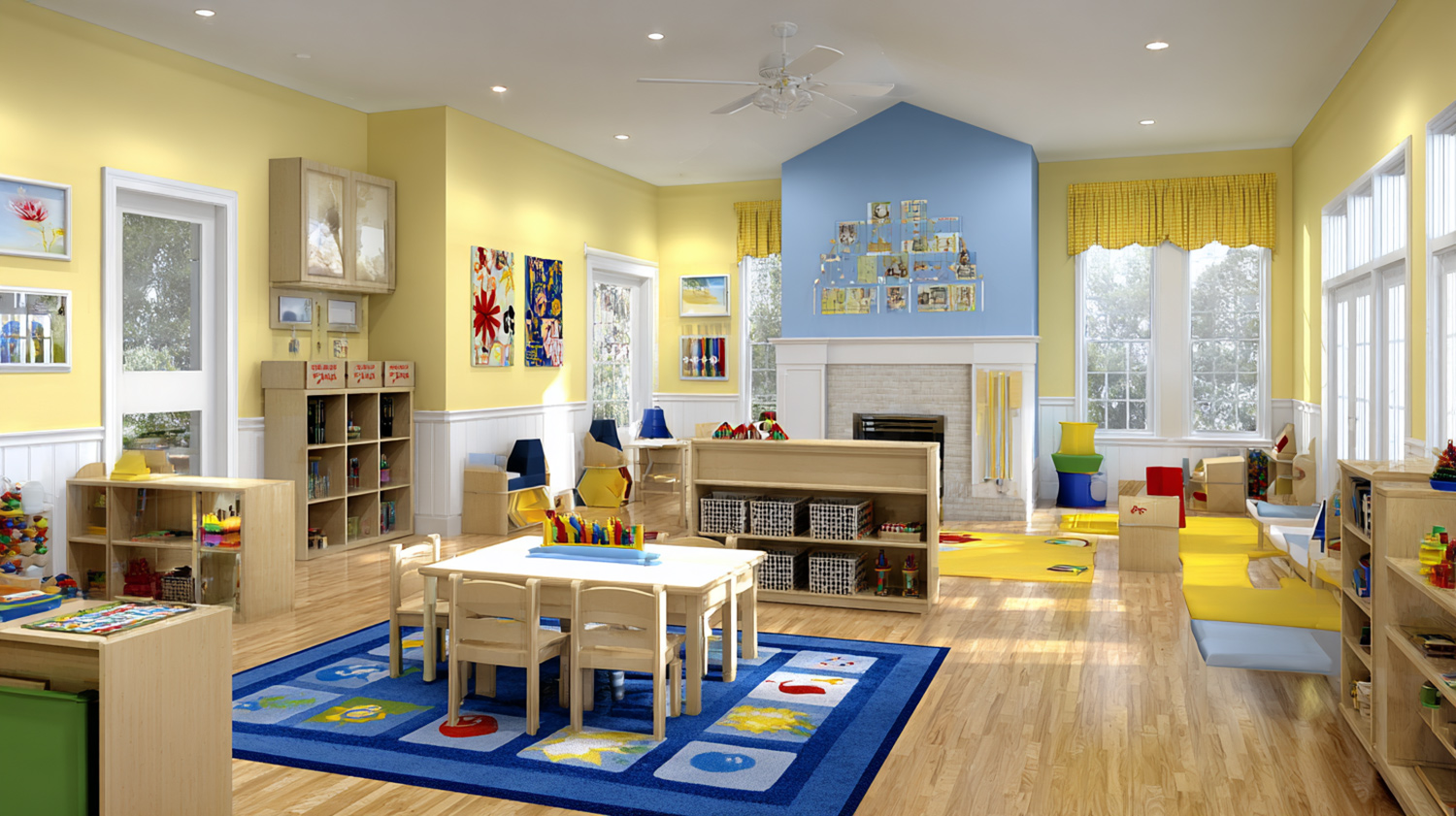
Look at how the space is organized. Is there room for children to move? Young children need physical activity—not just scheduled outdoor time, but opportunities to use their bodies throughout the day. Research has consistently linked movement with cognitive development. Are there areas for different kinds of play—dramatic play, building, art, books? Can children make choices about what they do, or is every moment structured?
Pay attention to the noise level. A good preschool classroom is rarely silent. You should hear children talking, laughing, occasionally disagreeing. Productive noise suggests engagement. What you don't want is chaos—children running without purpose, adults yelling to be heard, a general sense of disorder. But you also don't want the unnatural quiet of children who've been trained to suppress their natural exuberance.
• • •
The question of philosophy—Montessori, Waldorf, Reggio Emilia, play-based, academic—deserves attention, but probably less than the marketing suggests.
Each approach has something to offer. Montessori classrooms emphasize independence and self-directed learning, with carefully designed materials that teach specific skills. Waldorf prioritizes imagination, nature, and artistic expression, delaying formal academics until later. Reggio Emilia centers the child as a capable learner, with teachers following children's interests through long-term projects. Play-based programs trust that children learn through exploration and social interaction. More academic programs introduce letters, numbers, and structured activities earlier.
The research doesn't clearly favor one philosophy over another. What matters more is whether the philosophy is implemented well—whether teachers understand the approach deeply enough to use it effectively, and whether it genuinely fits your child's temperament and your family's values.
If your child loves order and repetition, Montessori's structured materials might feel like a gift. If they're a daydreamer who lives in imaginary worlds, Waldorf's emphasis on fantasy and creative play might be a better fit. A high-energy child who learns by doing might thrive in a play-based environment with lots of outdoor time. There's no universal right answer.
What should give you pause is a program that seems confused about its own identity—claiming to be play-based but filling the day with worksheets, or advertising Montessori but lacking trained teachers and proper materials. Ask how teachers were prepared to implement the approach. Ask what a typical day looks like. If the answers are vague or inconsistent, that's worth noting.
• • •
Some things, though, should concern any parent.
A preschool that discourages visits or makes parents feel unwelcome is waving a red flag. Quality programs embrace transparency. You should be able to drop in during the day, ask questions, speak with teachers. If a program seems defensive about parent involvement, trust your instincts.
High teacher turnover suggests problems—low pay, poor management, a difficult work environment. Young children form attachments to their caregivers, and frequent staff changes disrupt those bonds. Ask how long teachers have been at the school. If most are new, ask why.
Cleanliness matters more than aesthetics. A well-worn classroom with happy children is fine; a dirty bathroom or kitchen is not. Young children put things in their mouths, touch everything, share germs enthusiastically. Basic hygiene isn't optional.
Be wary of programs that promise too much academic progress. Developmentally appropriate practice for preschoolers focuses on building foundations—language, social skills, emotional regulation, curiosity—not drilling letters and numbers. Children who are pushed to read or do math before they're developmentally ready often end up frustrated rather than advanced. The research is clear that early academic pressure doesn't translate to long-term advantage and may actually backfire.
Screen time in preschool should be minimal to nonexistent. The American Academy of Pediatrics recommends limiting screen use for young children, and whatever media children encounter should be high-quality and interactive—not a way for teachers to occupy kids while doing something else. If screens are a regular part of the day, ask why.
• • •
Beneath all the practical questions lies a deeper one: What do you actually want for your child during these years?
The honest answer, for most parents, isn't "academic achievement." It's something harder to measure. You want your child to feel safe and loved outside the home. You want them to discover that learning is interesting, that other children can be friends, that adults can be trusted. You want them to develop the confidence to try new things and the resilience to handle disappointment. You want them to know that their feelings matter and that they're capable of more than they realize.
These outcomes aren't captured by standardized assessments or impressive-sounding curricula. They emerge from relationships—from teachers who see your child clearly, who meet them where they are, who create an environment where it's safe to explore and make mistakes.
When the preschool researchers talk about "quality," they mean something specific. They mean teachers who engage in rich, back-and-forth conversations with children. They mean environments where children have agency and choice. They mean programs that support the whole child—social, emotional, physical, and cognitive development together, not just academics in isolation. The National Academies of Sciences, Engineering, and Medicine synthesized decades of research and concluded that high-quality early childhood programs share common features: responsive relationships, language-rich interactions, play-based learning, and support for children's self-regulation.
These features don't require expensive facilities or branded curricula. They require adults who understand child development, who are supported and compensated fairly, and who have the time and resources to connect with each child.
• • •
In the end, choosing a preschool is not unlike choosing a neighborhood or a pediatrician or a community—you're looking for a place where your family fits, where your child will be seen and supported, where the values align closely enough with your own.
There will probably be compromises. The program closest to home might not have the longest hours. The school with the best teachers might have the longest waitlist. The tuition that works for your budget might mean accepting a higher child-to-teacher ratio than you'd prefer. These trade-offs are real, and there's no formula for navigating them.
But here's what's worth remembering: young children are resilient. They can thrive in many different environments, as long as the adults around them are warm, responsive, and reasonably competent. A preschool doesn't have to be perfect to be good enough. The pressure to find the single best option—the one that will optimize your child's trajectory—is largely a creation of anxiety, not evidence.
The most important thing you can do is pay attention. Visit the program before you commit, and visit again after your child starts. Talk to teachers. Watch your child. Are they excited to go in the morning? Do they talk about what happened during the day? Do they seem to be learning, growing, becoming more themselves?
If the answer is yes, you've probably made a good choice. If not, you can adjust. The research is reassuring on this point: what matters most in early childhood isn't any particular preschool program, but the accumulated experiences of responsive relationships and engaging environments. You're building a foundation, not sealing a fate.
Trust your knowledge of your own child. Trust your instincts about the adults who will care for them. And trust that the love and attention you bring to this decision—even in those anxious 2 a.m. moments—is itself a form of advocacy for your child's flourishing. That's what good parenting looks like, regardless of which preschool you choose.
Sources
- Center on the Developing Child at Harvard University. "Serve and Return." Harvard University, 2024.
- Education Endowment Foundation. "Play-Based Learning: Early Years Toolkit." 2024.
- Institute of Education Sciences. "Prioritizing Play: The Importance of Play-Based Learning in Early Education." U.S. Department of Education, 2024.
- Learning Policy Institute. "The Building Blocks of High-Quality Early Childhood Education Programs." 2016.
- National Association for the Education of Young Children. "The 10 NAEYC Program Standards." NAEYC, 2024.
- National Association for the Education of Young Children. "Staff-to-Child Ratio and Class Size." NAEYC, 2018.
- National Institute for Early Education Research. "Better Teachers, Better Preschools: Student Achievement Linked to Teacher Qualifications." NIEER Preschool Policy Matters, 2004.
- Regional Educational Laboratory West, Institute of Education Sciences. "The Relationship Between Preschool Teacher Qualifications and Student Outcomes." IES, 2019.
- University of Cambridge. "The Power of Play-Based Learning in Preschool and Elementary School." Edutopia, 2022.
- Zosh, Jennifer M., et al. "The Power of Playful Learning in the Early Childhood Setting." Young Children, National Association for the Education of Young Children, Summer 2022.